-
Wrapping my OER Course Conversion Journey
As the OER course conversion process winds down and I’m figuratively tying up the last few loose ends, I’ve had a chance to step back and really reflect. And honestly….this has been the cherry on top of what has become a three-year exploration into inclusion and accessibility. It started in spring 2024, when I enrolled in the CUNY SPS Disability Services in Higher Education Graduate Program. My goal was to become more grounded in my understanding of how to actually promote inclusion at the college level and serve students with varying needs more effectively. When I completed the program, I knew I wasn’t done. I still wanted to stay in…
You May Also Like
Teaching a Survey of Art History on the Commons
-
Teaching a Survey of Art History on the Commons
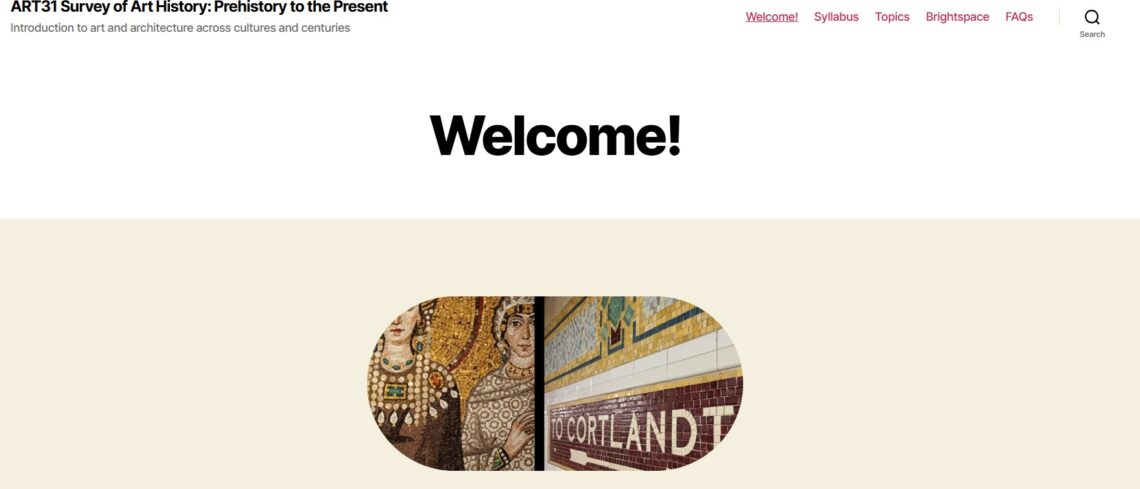
I built a course site on the Commons for my course "Survey of Art History: Prehistory to the Present. Introduction to art and architecture across cultures and centuries." When time and attention are in limited supply, I’d prefer the students to spend those precious resources on reflecting on, let’s say, the relationship between images and seals in Fang Congyi’s fourteenth-century handscroll ink painting, the symbolic meanings of the Ghanaian kente cloth and the Burberry tartan, or the profound sense of alienation in Manet’s A Bar at the Folies-Bergère, instead of trying to figure out the inner workings of a platform such as Brightspace that they will never use after graduation.
-
The Invisible Barriers: What I’ve Learned from OER Fellowship
I joined this OER fellowship for a pretty simple reason: textbooks cost too much, and my students shouldn’t have to pay $200 to learn calculus. That part hasn’t changed. But somewhere along the way, the work shifted on me. It stopped being just about finding free resources and started being about something bigger. The Cost Barrier is Just the Beginning I came into this with a clear conviction: textbook costs hurt students. That belief hasn’t changed—if anything, it’s deepened. But I now see that cost is one piece of a much larger puzzle. The question isn’t just “How do I make this course free?” It’s “How do I make this…
You May Also Like
Teaching a Survey of Art History on the Commons
-
From the Margins to the Center
When I reflect on the research I conducted for my dissertation, it focused on bringing those who have been regulated to the margins to the center (both in reimagining and reconstructing the Civil Rights Movement to highlight the role of Black Women, and in the composition classroom). Marginalized students, in particular, are often asked to consume knowledge and reproduce it in order to show progress- to demonstrate that they are learning, to show that, according to university standards, they are becoming “educated.” But are they? Is the process of regurgitating information, in which you have no agency, a demonstration of actual learning (is it a demonstration of intellectual, personal, and…
You May Also Like
Teaching a Survey of Art History on the Commons
-
Developing OER for Calculus III
I’m excited to be part of the Winter 2026 Math cohort for the Course Conversion Fellowship at Kingsborough. As an educator, I’ve always been interested in how we can make high-quality learning more accessible and equitable. This fellowship provides a dedicated space to move beyond traditional textbooks and explore the world of Open Educational Resources (OER) and Zero Textbook Cost (ZTC) materials. My primary motivation for joining this fellowship is to remove the financial barriers that often hinder student success in mathematics. By shifting to open resources, I hope to ensure every student has access to the required materials on day one. Over the next few weeks, I will conduct…
You May Also Like
Teaching a Survey of Art History on the Commons
-
Opening Up Calculus for Everyone
I’ve joined an OER project to convert Calculus I (MAT 1500) and Calculus II (MAT 1600) into zero-textbook-cost courses. Like many students, I know how expensive textbooks can be—especially for foundational classes like these. If we want our students to succeed in STEM, the first step shouldn’t be a $200 book. This isn’t just about finding a free textbook. It’s about building something better: interactive problem sets, videos that actually help, and real-world examples that make calculus feel relevant. I want these resources to be accessible, clear, and designed with Kingsborough students in mind. I’m looking forward to sharing what I build and learning from others in the OER community along the…
You May Also Like
Teaching a Survey of Art History on the Commons
-
Course Conversion for MAT 1500
I am honored to be part of this fellowship. My primary goal is to develop an accessible syllabus and designate the course as having zero textbook cost. Through this professional development experience, I hope to deepen my understanding of open pedagogy and open educational resources and to incorporate these approaches into my teaching in the future.
You May Also Like
Teaching a Survey of Art History on the Commons
-
OER for CLIP
Introducing the CUNY Language Immersion Program to OE Resources I am very excited to take part in this initiative and to bring these ideas to CLIP. Our students have been admitted to a CUNY college but have not started taking credit-bearing classes because of low language proficiency. As such, CLIP can be described as a feeder or gateway program, so investing in its development and sustainability impacts all of us. My experience in converting a for-credit course into an open educational resource has helped me improve my practice, and now I want to exted it to CLIP. The collective experience of dissecting each aspect of our courses and rebuilding them…
You May Also Like
Teaching a Survey of Art History on the Commons
-
Discussion Post 1 – Introductions I am planning to convert my Interpersonal Communication course (SPE 12) to OER because the subject relies so heavily on real discussions and looking at lifelike examples of relationships and conflict. Honestly, I have seen so many textbooks that just feel outdated. I see dialogue that students can’t relate to, like “Oh Wilfred, you’re a pill,” or descriptions of women that feel stuck in the past. One text I was required to use in 2004 when I was first hired had 0% about computers or technology and used descriptions like – Jean is a working woman who is nearing middle age but she still cares…
You May Also Like
Teaching a Survey of Art History on the Commons
-
Developing OER for Speech 1100 – Basic Communication Skills and Practice
I chose to convert Speech 11 with some hesitation. This introductory course in listening and speaking, formally titled Basic Communication Skills and Practice, comes with layers of complexity. Before I get into why this conversion feels both necessary and daunting, let me paint a picture of the course. Speech 11 is fundamentally about developing the comprehension of verbal and nonverbal communication and strengthening listening skills, particularly critical listening. Think of it as the foundation that students need before they ever stand up to give a public speech, it is the very beginning stages of presentational skills. Here’s where it gets complicated, my students are non-native American English speakers with varied…
You May Also Like
Teaching a Survey of Art History on the Commons