Uncategorized
-
Call for Participants- Open Course Refreshers!
Has it been a while since the course you’re teaching was converted to Zero Textbook Cost (ZTC) materials? Are you currently teaching a ZTC course, but would like to update it in a supportive and funded environment? Would you enjoy working with others to explore more about the wide world of open educational practices while updating your teaching materials? If you answered yes to any of these questions, then please apply to join our inaugural Open Course Refreshers Cohort! Refreshers will meet four times on Zoom during the Spring Semester to expand their knowledge of open educational practices and open platforms and to explore newly released OER and ZTC materials…
You May Also Like
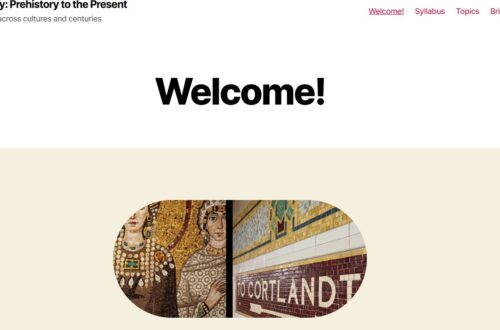
Teaching a Survey of Art History on the Commons
-
Redesign of math courses using OER – MAT 5600
Hi all! I am a new member of Kingsborough CC’s Mathematics department. I am passionate about providing open educational resources for students to use and have been a supporter of OER. It is no surprise that students don’t like to read math textbooks. Over the past few years, I noticed something interesting while teaching math courses. During remote learning, students enjoyed having the lecture notes shared by the instructor because they had more time allocated for class engagement. The students likely experienced that sometimes they were too busy copying what was written on the blackboard to listen to what the instructor was lecturing. As an experiment to promote student learning,…
You May Also Like
Teaching a Survey of Art History on the Commons
-
Using the Commons to streamline resources over time
Hello everyone! I started teaching in 1998 and have been a faculty member of Kingsborough’s English department since 2008. I haven’t yet decided if I am going to adapt Eng 24: Composition II or Eng 43: Drama on the Commons, but the aspect I would like to preserve (and improve) is the same for each. For either choice, the most functional part of my Blackboard course is also its most dysfunctional. In my BB shells, I always devote one of the side tabs to collect essential documents and links that can be referred throughout the semester. For my composition courses, it might be helpful handouts I’ve come across about writing,…
You May Also Like
Teaching a Survey of Art History on the Commons
-
Using CUNY Academic Commons to Engage Students
Hello, I’m Sarah Dillon, an art historian in Kingsborough’s Art Department. I have been teaching with Open Education Resources (OER) for a while now, thanks in large part to the efforts of Smarthistory, an OER with the mission of making “public art history.” I mention this at the outset because I am extremely grateful for resources like this, which have helped me move away from the traditional textbook model, but also because such resources put art historians like me in a somewhat unique position. With such an abundance of high-quality material available, I often find myself focusing more on curating and presenting the information in ways that best support my…
You May Also Like
Teaching a Survey of Art History on the Commons
-
Intro & A new vision for our capstone course – EDC 90
Hello! I teach in the Education Program – BEH Department and have been an educator for my entire career. I spent decades in grades PreK-12 before shifting to higher education. I consider it a privilege to work in a community college with preservice teachers as they examine their beliefs, articulate their teaching philosophy and begin to develop a professional identity . The Education Program has been engaged in a process of development and growth. As course coordinator of EDC 90, I facilitate the work of a committee engaged in examining and re-envisioning this capstone course. Together, we drafted a vision and created a menu of possibilities for the course. This…
You May Also Like
Teaching a Survey of Art History on the Commons
-
Challenges and Possibilities of Creating an OER for a Social Foundations of Education Course
Hi there – This is an introductory post about creating an OER for the Education Program’s EDC 200 – Social Foundations of Education course. To understand the goals and challenges of creating an OER for this course, I think it’s helpful to begin by giving a little background and history about the course. EDC 200 is the first course students in the Education major take but it’s also the most theoretical one. As is the case in most teacher ed programs, the course lays the theoretical “foundation” that students will need to meaningfully engage with the mostly more methods-focused courses that will follow. When I came to the college in…
You May Also Like
Teaching a Survey of Art History on the Commons
-
ZTC Attribute vs No Textbooks Assigned: Why is correct course marking important, and how can you do it?
If you have gone through the effort of designing your course to use Zero Textbook Cost (ZTC)1 materials so your students can learn without the additional burden of buying textbooks, thank you! But there are a few more steps you must take to mark your course with the ZTC attribute in CUNYFirst, and the process is definitely more annoying than it should be. Before explaining how to ensure your course is marked correctly, let’s talk about the why: applying the ZTC Attribute correctly is extremely important. First, it helps students find the courses that are actually ZTC, as the attribute can be used as a filter in the CUNY Class…
You May Also Like
Teaching a Survey of Art History on the Commons
-
Introduction and Goal
Hi! I am finally getting around to writing my introduction on here. I am looking forward to creating EDC 2500 into an OER course. I have been drawn to OER because of accessibility and also because I believe drawing from multiple sources creates a well-rounded experience for the students and exposes them to multiple perspectives. I think sticking to a textbook can make a course sometimes feels static and too prescriptive, whereas drawing from multiple sources based on student needs positions the content to become more dynamic and relevant. I believe that seeing and recognizing relevance is key to motivation. So, my goal is to ensure that key content is…
You May Also Like
Teaching a Survey of Art History on the Commons
-
OERs: The case for print copies at the library
When it comes to open educational resources, the idea of print copies at the library might seem redundant. After all, anyone with an internet connection can look at these materials freely online. That’s the whole point! The documents or links are likely posted to your course site, and students can print these documents (textbooks, readings, worksheets, whatever) themselves. I can certainly see how, from a teaching faculty perspective, involving the library and producing print copies might seem unnecessary. But I’d love to make the case for doing just that. Imagine you are a librarian during the first week or two of the semester, working at the reference desk. Along with…
You May Also Like
Teaching a Survey of Art History on the Commons
-
Introduction and thoughts about OERs in Composition classes
Hi, this is Rachel, from the English Department. OERs in writing classes are a little tricky because the “content” of Composition is a matter of significant disagreement. One school of thought is that “academic writing” means engaging with “academic reading,” which means students should read challenging material centered around some academic topic and develop thesis-driven essays using that material. But… many have challenged this definition of academic writing given that writing produced by people in the academy and by students in disciplines takes many different forms and often is not characterized by responding to and/or analyzing and/or synthesizing published texts. An alternative has been to substitute scholarly texts about writing,…
You May Also Like
Teaching a Survey of Art History on the Commons

