Uncategorized
-
Introduction and Goal
Hello! My name is Hun Bok Jung. I am an Assistant Professor in the department of Physical Sciences. Since joining Kingsborough Community College in Fall 2023, I have been teaching CHM 1100 General Chemistry I and CHM 100 Preview of General Chemistry courses both in person and online. My goal is to develop an open educational resource of General Chemistry on the CUNY Commons for students at CUNY campuses. Online open educational resources will benefit various kinds of students because they are easily accessible and our young generation of students are familiar with digital platform. I am excited to learn many things about CUNY Commons and I hope to have…
You May Also Like
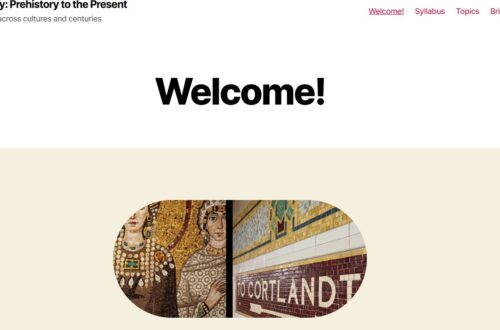
Teaching a Survey of Art History on the Commons
-
OER Reflections
In my first post I referenced my hesitation to produce OER content. I can now confidently say that I have increased that confidence through my experience in converting my Oral Interpretation speech course to OER/ZTC. What catapulted me into learning was Shawna Brandel’s clear instruction with great supporting documents. She did especially well with showcasing the work of other OER contributors which was of great value. I have included some of her recommendations in my content which I look forward to sharing with my students. One of the greatest benefits of this training was the emphasis on inclusion in the classroom (and workplace), and on various teaching strategies and pedagogues…
You May Also Like
Teaching a Survey of Art History on the Commons
-
Our students | Our selves: The hidden value of pedagogical development
One often overlooked benefit of professional development–pedagogical development in particular–is that it provides a rare opportunity to be a student again. To find yourself with an orientation and an objective, but in unfamiliar or challenging terrain. And (if you’re anything like me) to set off in too many directions at once, to expand the project beyond what is feasible, and finally, to panic at the enormous mess this produces. In this specific instance, I set out to overhaul my existing OER syllabus for my introductory course in U.S. government and politics. I opened my forever expanding “Notes for Next Semester” document and was reminded of all of the excellent ideas…
You May Also Like
Teaching a Survey of Art History on the Commons
-
Final reflection at the end of semester as OER liaison to Mathematics
I want to begin by thanking Shawna Brandle and Rina Yarmish for their unwavering support in my role as OER liaison within the mathematics department. I truly appreciated the opportunity to meet with everyone who shares a mutual passion for developing OER content. It is a great pleasure to work alongside many faculty/staff members across different disciplines. This semester has been exceptionally busy for me, with two major OER projects taking the forefront: Introducing WeBWork: I’ve been working diligently to introduce WeBWork, an online homework system tailored for math and science, to our department. Despite some technical challenges, including the pending setup of a local server with IT support, I’ve…
You May Also Like
Teaching a Survey of Art History on the Commons
-
Reflection on converting EDC2200: Art in Education Workshop to OER
This semester I converted EDC2200 Art in Education Workshop to an OER course. I have avoided using a textbook for many years, not just because of the prohibitive cost of most textbooks, but also to avoid the possibility of a single/narrow take on a subject governed by a publishing company. Choosing from a diverse array of materials allows for a wider range of perspective, narratives & counternarratives. While my course had been Zero Textbook, during the conversion process I realized that not all my resources were easily nor universally accessible. It was a lot of work to find universally accessible resources! The benefits, however, were many: I had to read…
You May Also Like
Teaching a Survey of Art History on the Commons
-
Final reflection at the end of semester as OER liaison to English
When I posted at the beginning of the semester I talked about how I wasn’t sure how useful OERs were to English Department faculty. So much of what we do, in writing classes in particular, is to guide student writing. This takes time but doesn’t require a lot in terms of materials or resources. Students often write about texts, for instance, but those can be anything and most teachers don’t require students to purchase expensive reading anthologies. There are writing guides one might assign, but often these are often too generic, too long, and not targeted to our students–in addition to being costly. I think most teachers feel pretty comfortable…
You May Also Like
Teaching a Survey of Art History on the Commons
-
Building your scholarly profile with the CUNY Academic Commons (or how to make your own website for free in 10 minutes or less)
The CUNY Academic Commons is an open source platform designed to support academic community-building, project development and publishing, teaching and learning, and social networking across CUNY. More simply, it’s free web space for the CUNY community (in fact, the site you’re reading this on is on the Commons!). You can do a lot on the Commons- you can use it for teaching (like these courses in Biology, True Crime/US Judiciary System, and International Relations,), program or project websites (such as UnHomeless NYC, Kingsborough Holocaust Center , KCeL, and OE@KCC), even conference websites (like the CUNY Language, Society, and Culture Conference). You can also make a scholarly profile website, like KCC…
You May Also Like
Teaching a Survey of Art History on the Commons
-
6300 OER Conversion
This collaboration process was very insightful. It had me step out of my comfort zone to explore new activities of teaching. I was very much reliant on a concrete textbook. This will be a very new experience working from a different perspective although still utilizing the same component of Introduction to Criminal Justice. It can be daunting to know that Intro is the entrance to the criminal justice major but I look forward to seeing how the student respond not having the expense of an expensive textbook. I hope this lessens stress and the OER process increases engagement and participation.
You May Also Like
Teaching a Survey of Art History on the Commons
-
General Biolog II OER Laboratory manual
I am particularly excited to share that Kristin, Farshad, Azure, and I have been diligently working on the in-person version of the General Biolog II OER Laboratory manual. We aim to create a standard manual and infuse it with Universal Design for Learning (UDL) principles and Justice, Equity, Diversity, and Inclusion (JEDI). This approach ensures that our educational resources are accessible and inclusive to learners from diverse backgrounds and abilities. I am proud to announce that the first edition of our lab manual will soon be published on CUNY’s PressBooks platform, marking a significant milestone in our commitment to open education and inclusive pedagogy. We extend our heartfelt gratitude to…
You May Also Like
Teaching a Survey of Art History on the Commons
-
Final Reflection
This semester, I worked on a course conversion for EDC 2400: Teaching Emergent Bilinguals. One of the biggest challenges was to examine the wide range of materials that are available online and select them to ensure that not only do they address the content of the course, but also that they present multiple means of representation, giving learners various ways of accessing new content. As I redesigned the course syllabus, I included materials that are to be assigned as homework or used during class, as well as additional resources that might be useful for students and other instructors. I included videos, blogs, podcasts, and articles that can be accessed through…
You May Also Like
Teaching a Survey of Art History on the Commons

